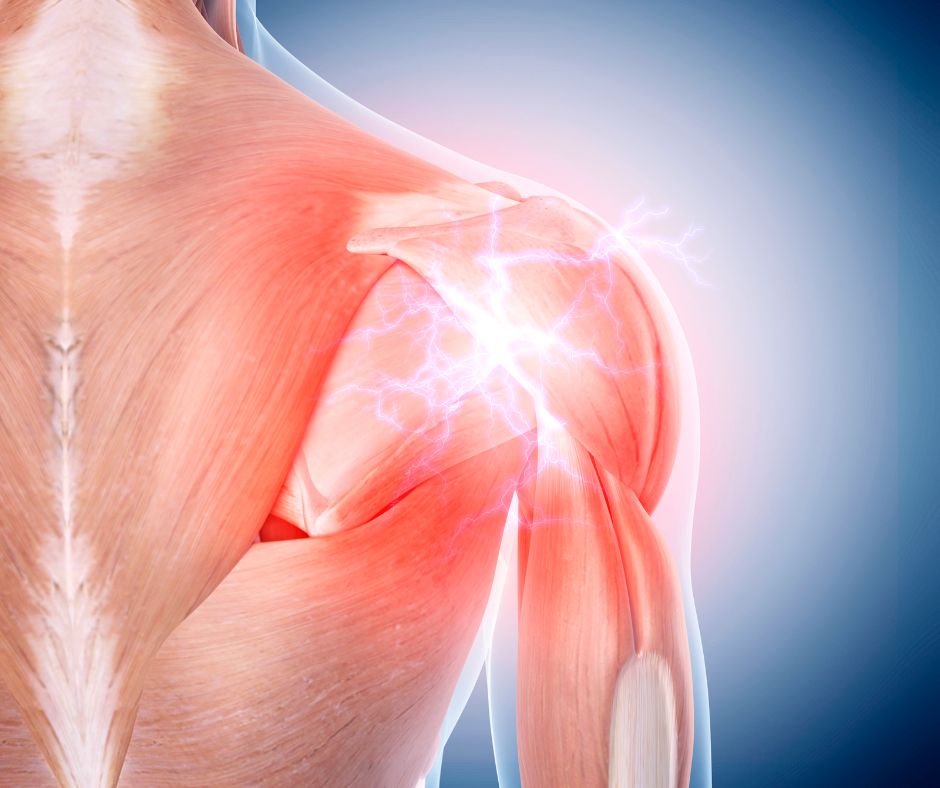
Shoulder pain is one of the most frustrating problems to solve. You’ve probably tried rotator cuff exercises, stretching, maybe even injections or physical therapy. Some things help temporarily, but the pain keeps coming back. That’s because most treatments focus on the shoulder itself. The real problem starts with what’s happening below.
Your Shoulder Needs a Stable Platform
Your shoulder is like a golf ball sitting on a tee. It’s designed for incredible mobility—more range of motion than any other joint in your body. But that mobility only works when it has a stable platform to work from.
That platform is your shoulder blade. And your shoulder blade depends entirely on having a stable, well-aligned spine and rib cage to attach to.
When that platform becomes unstable, everything about your shoulder changes.
What Happens in Our Screen-Based World
Here’s the pattern we see constantly. You sit hunched forward for hours. Your mid-back rounds. Your rib cage collapses inward. Your shoulder blades lose their stable platform.
Now your shoulder blades start winging out, rolling forward, desperately trying to find stability somewhere. Your rotator cuff muscles—those small stabilizers inside the shoulder joint—are working overtime just to keep your arm bone in the socket.
It’s like trying to throw a fastball while standing on a wobbly platform. Doesn’t matter how strong your arm is. You can’t generate proper force or control when the foundation is unstable.
This is where posture therapy for shoulder pain changes everything.
The Dangerous Downward Spiral
This platform instability creates a dangerous spiral. Your rotator cuff gets overworked and inflamed. You develop impingement—that pinching sensation when you raise your arm. You might get a partial tear. Maybe a full tear if the pattern continues long enough.
Meanwhile, your bigger muscles like your traps and lats start taking over jobs they weren’t designed for, creating even more dysfunction. Your neck gets tight. Your upper back gets tense. The whole area becomes a mess of compensation patterns.
So you stretch. You strengthen. You get injections, maybe surgery. But nothing lasts because you’re not addressing the platform problem.
Your Postural Chain—those deep stabilizers that support your spine and rib cage—isn’t working properly. Until that gets fixed, your shoulder will keep struggling.
Why Rotator Cuff Exercises Aren’t Enough
Traditional approaches to shoulder pain focus heavily on rotator cuff strengthening. Those exercises aren’t wrong. The rotator cuff definitely plays a role in shoulder stability.
But here’s the catch: strengthening your rotator cuff while your shoulder blade platform remains unstable is like putting a stronger engine in a car with a broken frame. You’re not addressing the real limitation.
Your rotator cuff can get as strong as you want. If it’s still working from an unstable platform, it’s still going to struggle. It’s still going to get overworked. The pain is still going to come back.
Posture therapy for shoulder pain addresses the platform first. Once that’s stable, rotator cuff work actually makes sense.
What Posture Therapy for Shoulder Pain Actually Does
Posture therapy for shoulder pain restores the foundation your shoulder depends on. When your deep core muscles, your diaphragm, and your spinal stabilizers start working properly, your shoulder blade finds its natural position.
Clients are often surprised when we work on their breathing and core stability, and their shoulder pain disappears. We’re not even touching their shoulder directly. But we’ve given their shoulder what it’s been desperately looking for—a stable, well-aligned platform to work from.
When your Postural Chain functions properly, your shoulder blade sits in its proper position. Your rotator cuff can do its actual job—controlling precise shoulder movements—instead of fighting for basic stability all day.
Movement becomes smooth and pain-free. Not because we made your shoulder stronger, but because we made the platform it works from stable.
The Connection Most People Miss
Your shoulder blade attaches to your rib cage. Your rib cage position depends on your spine. Your spine position depends on your pelvis. Your pelvis position depends on your hips and core.
It’s all connected.
When your pelvis tilts forward, your lower back arches excessively. This forces your mid-back to round forward to compensate. That rounded mid-back pulls your rib cage down and in. Your shoulder blades lose their stable attachment point.
That’s why posture therapy for shoulder pain often starts with work nowhere near the shoulder. We’re tracing the chain back to where it first broke down. Fix that, and the shoulder problem often resolves on its own.
Common Shoulder Pain Patterns We See
Shoulder pain from platform instability shows up in predictable ways:
Rotator cuff tendinitis or impingement that won’t fully heal usually indicates shoulder blades that can’t maintain proper position, forcing the rotator cuff to overwork.
Pain with overhead reaching often comes from a rib cage that’s collapsed downward, limiting how much your shoulder blade can rotate upward.
Chronic upper trap and neck tension typically signals shoulder blades that are unstable, requiring bigger muscles to take over stabilization duties.
Pain that’s worse after sitting at a computer suggests the rounded posture from desk work is directly creating shoulder blade instability.
Different symptoms, same root cause: an unstable platform forcing your shoulder to compensate.
Your Shoulder Isn’t Broken
If you’ve been dealing with chronic shoulder pain, you might have been told your rotator cuff is weak. That you need to strengthen it more. Maybe you’ve been told the damage is just part of aging or overuse.
None of that captures what’s really happening. Your rotator cuff isn’t weak—it’s trying to do an impossible job. Working from an unstable platform, any muscle will eventually break down.
The “damage” you see on imaging—tendinitis, tears, bone spurs—is often the result of years of working from that unstable platform. It’s not random deterioration. It’s predictable breakdown from abnormal mechanics.
Posture therapy for shoulder pain addresses those mechanics. Get the platform stable, and suddenly your shoulder can function the way it should.
Beyond Temporary Fixes
Stretching your tight pecs might feel good temporarily. Strengthening your rotator cuff might help a bit. Adjustments or massage might provide relief. But if the platform remains unstable, you’re back to square one as soon as you return to your normal activities.
The fix isn’t in doing more shoulder work. It’s in restoring the stable platform that allows shoulder work to actually be effective.
Posture therapy for shoulder pain gives you that platform. Once it’s stable, all those other treatments and exercises can actually create lasting change instead of just temporary relief.
What Changes When the Platform Stabilizes
When we restore foundational support through posture therapy for shoulder pain, the changes can be dramatic:
Your shoulder blade settles into its natural position. That winging or forward rolling stops because the blade finally has somewhere stable to attach.
Your rotator cuff can relax. It’s no longer desperately working to stabilize a joint on an unstable platform.
Overhead reaching becomes easier. Your shoulder blade can rotate properly because your rib cage isn’t collapsed.
The chronic tightness in your neck and upper traps releases. Those muscles don’t need to help stabilize your shoulder blade anymore.
Pain that’s been there for months or years starts backing off. Not because you did more shoulder exercises, but because the reason your shoulder was struggling in the first place is gone.
Stop Treating Your Shoulder, Start Fixing Your Platform
If you’re dealing with shoulder pain that keeps coming back, the solution might not be in the shoulder itself. It’s in restoring the stable platform your shoulder depends on.
Posture therapy for shoulder pain gives you that foundation. We don’t just work your rotator cuff harder. We restore the spine, rib cage, and shoulder blade stability that makes proper shoulder function possible.
Your shoulder has been working from an unstable platform. Give it the stability it needs, and it can finally stop hurting.
Tired of shoulder pain that won’t resolve? Schedule a discovery call with Function Rx to learn how posture therapy for shoulder pain can restore the stable platform your shoulder needs—and finally give you lasting relief.