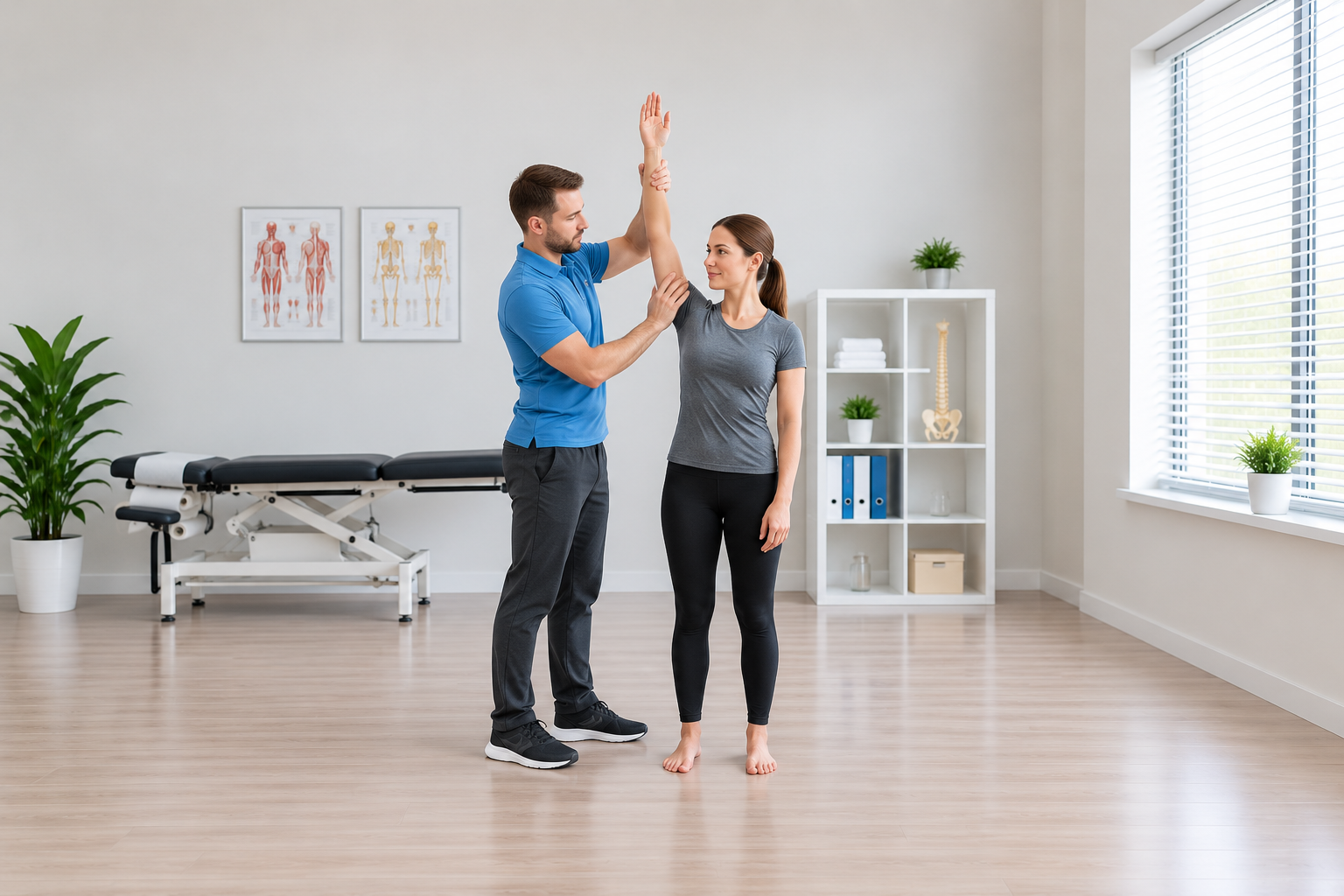
Some clients test well and still aren’t well. Their range of motion is full. Their strength is fine. They keep coming back with the same complaint.
Range of motion testing answers one question: what a joint can do. It doesn’t tell you what the body does when nobody is testing it.
That gap is where a lot of stubborn cases sit → and it’s what a standardized posture assessment is built to show.
What a Standard Exam Covers
A typical chiropractic exam is thorough. Dr. Anthony Cipperoni, a chiropractor and Function Rx co-founder, describes his own this way:
- Movement testing: how far and how well a joint moves
- Muscle testing: whether a muscle can produce force on demand
- Palpation: what the tissue and joints feel like under the hands
Each of those is useful. Each one also tests a part, in the moment, with the client’s full attention on it.
Here’s what’s missing: a standardized look at posture, and a baseline you can measure against later.
What Range of Motion Testing Misses
Let’s keep it simple. A test shows capacity. Posture shows the default.
A client can lift an arm through full range when you ask. That tells you the shoulder is capable. It doesn’t tell you where that shoulder sits for the other 16 waking hours, or which muscles are holding it there.
Three things tend to slip past a test-based exam:
- Where the body rests. How the pelvis, spine, and head line up when the client simply stands.
- What’s compensating. Which surface muscles are doing a job that belongs to the deep stabilizers.
- Change over time. Without a recorded baseline, “better” comes down to how the client feels that day.
None of this makes movement testing wrong. It means it’s answering a different question.
What Posture Photos Show
A Function Rx assessment is a set of seven photos: four standing views, and three test positions taken from the side.
Here’s the breakdown of what our team reads from them:
- Where the Postural Chain is failing. The body sinks with gravity in a recognizable way, such as a posterior pelvic tilt, a flattened low back, or a head sitting forward.
- Where compensation is present. Surface muscles pull the body the other way, as with an anterior pelvic tilt or visible bracing.
- How the kinetic chain responds. The test positions show whether a change at one end of the body carries through to the other. Where it stops points to a postural disconnect.
Photos have another advantage: they’re consistent. A 2022 systematic review of non-radiographic ways to measure forward head posture found the strongest evidence of reliability for measurement from photographs. The same review noted that evidence for validity is thinner.
Our assessment is a trained clinical read of standardized photos. It isn’t a validated measuring instrument, and we don’t present it as one.
Flexible and Still Weak
This is the case that surprises practitioners most.
We see many clients with perfectly good range of motion whose photos show a weak Postural Chain. Some are hypermobile, meaning their joints move beyond the typical range.
On a movement test, these clients look great. Nothing is restricted. Nothing is tight.
Their photos tell a different story. The pelvis is tucked under. The low back is flat. The head sits forward. The joints have plenty of range, and the deep muscles aren’t holding any of it.
It’s common, and it’s easy to miss → because a test built to find restriction won’t flag a body that has too little support.
A Baseline You Can Measure Against
The second thing photos give you is a record.
After four sequences, about a month of daily work, the same seven photos are taken again. The two sets go side by side. The reassessment shows:
- Where posture has improved
- What still needs work
- What the next round of sequences should target
It changes the conversation with the client. You aren’t asking them to trust that they’re improving. You’re showing them.
It also helps with follow-through, because clients who can see their progress have a reason to keep going. We cover that side in our guide to home exercise compliance.
What Photos Can’t Tell You
A posture assessment has limits, and they matter.
Photos can’t show an underlying injury or a disc problem that neither you nor the client knows about. That kind of problem can be the reason the posture looks the way it does.
So a posture assessment sits alongside your exam. It doesn’t replace it.
- Your exam comes first. History, movement testing, muscle testing, and palpation still do their jobs.
- Imaging is sometimes necessary. When the picture doesn’t add up, or a client isn’t responding as expected, that’s a reason to look further.
- Photos describe. They don’t diagnose. They show how a body is holding itself. Why is still a clinical judgment.
It works best as one more source of information, because it answers the question your other tests leave open.
How Function Rx Fits
Reading posture photos well takes training. Function Rx does that part for chiropractors, personal trainers, and workplace wellness providers, in person or remote.
- You take the seven photos. It takes as little as 10 minutes.
- Our posture therapy team reads them and builds four sequences around what they show.
- You review and approve the sequences before your client sees them.
- Your client does the work in the app, with virtual appointments available if they need guidance.
- You reassess, with add-on sequences for clients who continue.
A clinic subscription keeps the photos, the sequences, and the progress in one place → so you add a standardized baseline to your exam without adding to your workload.
See how it works for practitioners → functionrx.health/practitioners
Your clients can read what to expect in our posture assessment guide. For the bigger picture, start with why adjustments don’t hold.
From “tests fine, still hurts” → to a clear picture, and a baseline to measure against.